• Facebook
  • X
  • Pinterest
  • Instagram
  • Youtube
  • LinkedIn
Shine
  • Services
    • Classes
      • Signature + Custom Classes
      • Little Luminaries
    • Workshops
    • Parties + Events
      • Children’s Parties + Events
      • Adult Parties + Events
    • The Shine Studio
    • Hamptons Summer Camps
    • Craft Bags and Online Classes
  • About Us
    • Who We Are
    • Testimonials
    • Press
    • Friends Who Shine
    • Partnerships
    • Job Opportunities
  • Blog
  • Contact Us
  • Search
  • Menu Menu

The Importance of Music in Early Childhood Development

Home | Learn | Page 9

The Importance of Music in Early Childhood Development

October 18, 2018/in Guide, Learn, Play/by Shine

“The potential possibilities of any child are the most intriguing and stimulating in all creation,” once said Ray L. Wilbur, the third president of Stanford University. As parents, we yearn to give our children the best foundation. We want them to be happy, talented, intelligent, and successful. Recent advances in neuroscience have allowed a window into the many ways music molds the developing brain, hard-wiring it for all these ambitions.

What Does Research Say About The Importance of Music in Early Childhood?

There is an exhaustive body of research selling music as a pathway to intelligence, ability, and overall happiness. In his 1983 theory of “multiple intelligences,” psychologist Howard Gardner posited that music intelligence is as important as logical and emotional intelligence based on the way that music strengthens the mind-body connection. For instance, children develop better motor skills when movement is combined with music. Neuroscientists have observed noticeable differences in the spatial awareness and language processing centers of the brain in young musicians.

Scientists have called music “a breakthrough” for children ages two to nine. After 15 months of weekly musical instruction, sound discrimination abilities, fine motor skills, and spatial intelligence improve. By age six, children taking music lessons score at least three IQ points higher than their peers. Elementary school children in the best music education programs score about 22 percent higher in English and 20 percent higher in math on standardized tests. The social advantages are not to be overlooked. Though it can be difficult to quantify, music will make your child more interesting and happier. As Dr. Eric Rasmussen of Johns Hopkins University explains: “It gives you a better understanding of yourself… how you think and express yourself are enhanced.”

When Should I Focus on Music Development for My Child?

Researchers describe the ages of 0-6 as the “music babble” stage, where children approach music in a way that is totally different from adults. During these formative years, children do not yet understand the tonalities, meters, and rhythms of music, but they are developing a foundation for music competence.

Children move through the following stages of music knowledge:

  • Acculturation (Birth to Ages 2-4): Unstructured music education provides children with exposure to different tones, keys, harmonies, and meters. Instrumental music works best for children to absorb the different sounds of their environment. Typically, by about 18 months, you will begin to notice the benefit of guided music acculturation over children who have not had the same exposure. Children begin to babble sounds and practice choreographed movements. By the end of this stage, they will echo the tonal and rhythmic patterns they hear, though their performances can still be somewhat hit-or-miss.
  • Imitation (Ages 2-4 to Ages 3-5): Children begin to transition to more purposeful musical action and learn how to teach music to themselves. Rather than directly imitating the adults they hear, children become aware of their own patterns. Eventually, incorrect imitations move toward greater accuracy.
  • Assimilation (Ages 3-5 to Ages 4-6): At this stage, youngsters become aware of musical syntax and comprehend musical phrases. They can perform patterns with precision and coordinate tonal patterns into singing.

During these formative years, the brain is extremely active and flexible in laying down the circuitry for lifelong musical reception and expression. Beyond these early years, you can expect to see impressive gains in your child’s musical aptitude and a mastery of the chosen instrument. Opportunities to travel, perform in large music halls, participate in summer festivals, and develop an identity tied to music aptitude now open up to your child.

What Kind of Music Exposure Does My Child Need?

Northwestern University researchers debunked the so-called “Mozart” myth, which theorized that children who simply listen to classical music develop superior intelligence. Rather, scientists discovered that it’s the act of generating and manipulating sound that rewires the brain for success.

“Making music matters,” they concluded, in the same way that playing sports impacts physical fitness (not watching sports). Parents play a critical role in facilitating a love of music and all the benefits that come along with it. To cultivate a lifelong love of music, parents should follow their intuition, find music their kids love, hire good teachers, and let their child discover an instrument they truly like. Much early childhood music inspires a love of music through the language children speak: play!

The effects can be astounding. Since 2008, 93 percent of low-income children in Los Angeles taking music instruction have gone on to college, despite a dropout rate above 50 percent in their neighborhoods.

How To Help Your Child Shine

Shine offers early music development classes based on the latest research, starting with babies who are less than a year old. Music Stars is our signature music class, incorporating song, storytelling, instruments, and upbeat movements for aspiring young musicians of all ages. Sing & Shine helps ages 0-2 with a themed exploration of instruments, game play, familiar songs, and rock n’ roll with the support of a caregiver. For ages 3-5 or 6-8, we offer Stage Lights, a creative performance class that incorporates puppetry and masks in with music and movement. At age 5, your child can begin more formal Group Music Theory or Private Piano and Guitar lessons. We’re offering cool new Bass and Percussion instruction for older kids now as well. Contact us to learn more.

ADDITIONAL RESOURCES:

https://www.musictogether.com/about/research/research-based-program/importance-of-music-in-early-childhood

https://www.scholastic.com/teachers/blog-posts/elaine-winter/2017/Why-Music-Matters-in-the-Early-Childhood-Classroom/

https://www.parents.com/kids/development/intellectual/6-benefits-of-music-lessons/

https://www.foxnews.com/health/how-important-is-music-education-in-schools

https://shinenyc.net/wp-content/uploads/2018/10/Untitled-2.jpg 963 1001 Shine https://shinenyc.net/wp-content/uploads/2021/02/Shine-logo-300x220.png Shine2018-10-18 20:23:132024-09-26 15:59:03The Importance of Music in Early Childhood Development

A Few Fun Things To Do In NYC and The East End Before Summer Is Over

August 21, 2018/in Celebrate, Fun, Guide, Learn, Play/by Shine

“Summer will end soon enough, and childhood as well,” once said Game of Thrones author George R.R. Martin. The thought of these warm, sunny afternoons coming to an end is enough to put a brief chill in your bones. Thankfully, New York City and Long Island’s East End offer a plethora of last-minute events, giving us that one last taste of summer. Here are a few activities we recommend…

Color Factory

The Color Factory pop-up exhibit started in San Francisco and makes its Soho debut on August 20th in a 20,000 square-foot commercial space located at 251 Spring Street near Avenue of the Americas. It’s hard to imagine what your Instagram might be missing, but how about wading in a bright yellow sea of 207,000 balls? Or perhaps you’d like a photo of your little ones on rainbow-colored stairs that seem to go on for miles? Kids and grownups alike will love grooving on the luminous dance floor, designing their own custom color ice cream scoop, walking along a giant infographic to reveal their “secret color,” and gazing upon floating balloons with wishes for the world written by students at 826NYC. The collection of 16 unique exhibits inspires wonder and fosters art appreciation. Before you leave, be sure to grab a “Local Color” neighborhood map that directs you to 20 unique color experiences hidden in downtown Manhattan to discover.

The Color Factory
251 Spring Street
Manhattan, NY 10013

Get your tickets here. (Kids 2 and under are free!)

Pier 2 Pop Up Pool

While McCarren Park’s new pool soaks up the spotlight, you and your family can slink off to Brooklyn Park’s coolest “hidden gem.” The Pop-Up Pool is a small, kid-friendly 3.5-foot-deep pool that allows just 60 people in at a time between 10 am and 5 pm. Arrive at least 30 minutes prior to get free, “first come first served” wristbands for your 45-minute session. You’ll also find a nice sandy beach area with umbrellas, prime for relaxing; a concession stand serving burgers, dogs, and ice cream; plus you have all the beauty of Brooklyn Bridge Park at your disposal, with its playgrounds, picnic tables, rolling greens, volleyball courts, soccer fields, and public art displays. Try to go on a weekday when it’s less crowded if possible. Otherwise, keep the sprinkler park on Pier 6 or a stop at Ample Hills Creamery on Pier 5 in mind as your back-up option to avoid disappointment.

Brooklyn Bridge Park, Pier 2
150 Furman St.
Brooklyn, NY 11201

Candytopia

The Candytopia interactive art installation is recommended for anyone who has ever dreamed of eating their way through the Candyland board game or taking a tour of Willy Wonka’s Chocolate Factory. You’ll be treated to candy portraits inspired by Andy Warhol, Van Gogh, and Leonardo daVinci. You’ll see flying unicorn pigs, a candied sphinx, and a pit of marshmallows. There’s no shortage of photo opps throughout the sugary spectacle. Gummy candies, chocolates, nostalgic favorites, and other sweets will be provided throughout your tour to satisfy your sweet tooth. This whimsical wonderland is only open August 15th through November 15th, so get in while you can!

Penn Plaza
145 W 32nd Street
New York, NY 10001

Get your tickets here! (Children 3 & under are free.)

2018 Riverhead Railroad Festival

Train-obsessed kids can get a close-up look at some of Long Island’s historic railcars August 25th-26th from 10 a.m. to 4 p.m. Take the 10:15 AM Greenport Scoot to visit the Greenport Museum, with a ride back to Riverhead at 12:50 PM. Ride on a restored 1964-1965 LIRR World’s Fair park train. Visit a historic Lionel layout. Race miniature locomotives. Purchase your own train set. See G, O, HO, N and Z scale layouts. See historic blacksmithing demos. Enjoy refreshments and live music.

Railroad Museum of Long Island
416 Griffing Avenue, Riverhead
Fourth Street, Greenport

Get tickets at the box office for just $10. (5 and Under free!)

Harbes Family Farm Watermelon Festival

Calling all watermelon lovers August 25th-26th from 10 am to 7 pm! Harbes Family Farm welcomes you to a day full of contests from watermelon rolling to seed spitting. Kids will love the Barnyard Aventure – a singing hayride that tours the 100-acre farm, complete with pig racing and other friendly farm animals. Other highlights include: giant bouncing pillows; a goat bridge and mountain slide; a Sports Zone with baseball, football, and basketball toss games; and a hands-on preschooler playland. Adults will be treated to the relaxing sound of live rock, pop, and blues in the courtyard from 1-5 pm. Don’t forget to pick your own perfect watermelon and grab a bottle of their award-winning wine to take home.

Harbes Farm & Vineyard
715 Sound Avenue
Mattituck NY 11952


Contact Shine to find out many more ways to make the end of summer meaningful.

https://shinenyc.net/wp-content/uploads/2021/02/Shine-logo-300x220.png 0 0 Shine https://shinenyc.net/wp-content/uploads/2021/02/Shine-logo-300x220.png Shine2018-08-21 20:42:012024-09-26 15:59:03A Few Fun Things To Do In NYC and The East End Before Summer Is Over

10 Amazing U.S. Family Vacations To Take Before Your Kids Turn 13

July 22, 2018/in Fun, Learn/by Shine

Material gifts are fun, but their impact is fleeting. Instead, save your pennies for family travel, say child development researchers. The Journal of Commercial Research found that visiting a new place offers mental stimulation and crucial bonding time with family members. “Younger travelers had better grades in school, a better understanding of finances, a deeper sense of identity, and broader perspectives of the world,” reports WKBW Buffalo.

People will say to you travel is wasted on the young – that they won’t remember any of it. But travel is about more than taking photos to look back upon later. Like a good-night story or a trip to the playground, travel encourages children to use their imaginations, stimulates open-mindedness, teaches them to adapt to new situations, and helps bridge the gap across developmental milestones.

So, plan your trips guilt-free. Orchestrating a family vacation requires a bit of work and a lot of patience, but you’ll all be better off for it. If you’re keeping a bucket list, add these 10.

1. Lake Champlain, VT

Ideal For: Babies & Toddlers

Best Time To Visit: The resort is open late May through mid-September, with special rates available in May, June, and September.

Why Go: The Tyler Place Family Resort is a huge draw, offering unique programming for newborns up to 30 months, a kids camp for toddlers, and Parents’ Night Out babysitting whenever you wish. Parents enjoy cocktails by candlelight, while knowing their kids are well attended with one stand-in caregiver for every two children. When you wish to spend time together, you can take advantage of bikes with baby seats, craft activities, water sport outings, and parents’ helpers to come along on your excursions. With a playhouse playground, fishing, water play areas, theme parties, campfires, storytelling, teepees, tree houses, and all-inclusive pricing, what’s not to love?

More To Do: You may never want to leave the resort, but there is plenty to do in the surrounding area if you’d like to taste a little of Vermont. Forty-five minutes from the resort in South Hero, Allenholm Farm is a fun place to cycle, pick apples, visit friendly farm animals, and grab a farm-to-table bite to eat. On a rainy day, the ECHO Science Museum offers hands-on exhibits encouraging play and learning for the 0-6 crowd. Other fun places for little tikes include: Lake Champlain Chocolates, The Shelburne County Store, the Shelburne Museum, and The Vermont Teddy Bear Company. Be sure to visit Ben and Jerry’s! The Jay Peak Resort offers a climbing gym, movie theater, indoor ice arena, and indoor waterpark for older kids, ideal for a rainy day.

2. Disney World – Orlando, FL

Ideal For: Any age, though kids under 5 will have ride height and stamina limitations. Kids under 3 are free! Four-to-eight tend to be the sweet spot. Once your kids hit 44” in height, the World is their oyster.

Best Time To Visit: March to May offers pleasant weather (50s-80s) and the most agreeable prices, especially if you avoid holiday weekends or standard school recesses. September to mid-November is another excellent time to find reasonable rates and comfortable temperatures, although it falls in the June-November hurricane season. The worst times to book are during the November to February rush or the summer humidity.

Why Go: Walt Disney World in Orlando is ranked by Trip Advisor as “the #1 Best Family Vacation in the USA” – and for good reason. There’s no other place in America that celebrates childhood and tugs at the heart strands more than Disney World. Designed to be “the happiest place on Earth,” a Disney vacation is designed to be as stress-free as possible with effortless travel between parks, all-inclusive wristbands, attractions for all ages, and over-the-top friendly staff. The rides are epic journeys through entire films and the realms Disney has created; even the queues are attractions in and of themselves! On top of that, you’ll be treated to character meet-and-greets, parades, firework displays, princess makeovers, and world-class performances. The Disney World park system includes kid-favorite Magic Kingdom, parent-favorite Epcot, Animal Kingdom, Hollywood Studios, and two water parks – Typhoon Lagoon and Blizzard Beach. You could feasibly see a different park every day during your trip, though Park Hopper passes let pros navigate between the parks within the same day.

More To Do: In addition to Disney World itself, Orlando offers the Wizarding World of Harry Potter at Universal Studios, SeaWorld Orlando, the Kennedy Space Station, the Orlando Science Center, Legoland, Gatorland, a Ripley’s Believe It Or Not museum, and the Crayola Experience.

3. San Diego, CA

Ideal For: Ages 3-13

Best Time To Visit: September through November is always a terrific time to visit, but particularly October – which offers free child tickets along with the purchase of an adult ticket for most major attractions. You can also find decent rates and low traffic in March and April. May and June tend to have the most overcast days, while the winter months see the most rainfall – so you’ll want to avoid those times if that sort of weather matters to you.

Why Go: San Diego boasts warm weather year-round and loads of family-friendly attractions. The San Diego Zoo is one of the nation’s treasures and one of the places to see giant pandas, Australian koalas, Sumatran tigers, naked mole rats, California condors, and polar bears. Over 4,000 animals from 800+ species are assembled in this one magical place, including many rare and endangered.

More To Do: In addition to the San Diego Zoo, Balboa Park is a great place to kick off your trip among beautiful gardens and museums. Kids love The NAT’s animatronic dinosaurs, the kids’ aviation hangar at the San Diego Air & Space Museum, hiking among towering palm trees at the Palm Canyon Trail, hands-on science displays at the Reuben H. Fleet Science Center, the New Children’s Museum, SeaWorld San Diego, the antique carousels at Seaport Village, the “Coney Island” type experience at Belmont Park, and the Cabrillo National Monument’s tide pools. With 70 miles of coastline, you’ll find plenty of sand for a carefree holiday. Seashell-packed Silver Strand, surfer hangout Oceanside, swimming and picnicking at Mission Beach, La Jolla’s sea lion watching, and the quaint Coronado are a few area favorites.

4. Massachusetts

Ideal For: Toddlers & Early Elementary School Age

Best Time To Visit: The weather is warm from late March through October. Tourist traffic tends to be heaviest in the summer months once school lets out. The autumn months represent a particularly scenic (and affordable) time to visit New England in all its splendor.

Why Go: Cape Cod gets all the publicity for being a family-friendly vacation destination, but there’s much to do elsewhere in Massachusetts. Plan your trip around the Iconic Illustrators’ Trail for starters, which includes stops at The Springfield Museum (home of the new Amazing World of Dr. Seuss Museum), the Eric Carle Museum of Picture Book Art in Amherst, and the Norman Rockwell Museum in Stockbridge. Then make your way to Edaville, an amusement park featuring vintage carousels and Ferris Wheels, in addition to a Thomas the Train land and outdoor Dino Land trail with life-sized dino statues. Themed weekends include Superhero & Princess weekend, Curious George Weekend, and seasonal events like the “Not So Spooky Halloween” in October, and our Christmas Festival of Lights.

More To Do: Older kids might enjoy an additional beeline to historic Plymouth Rock, which will supplement what they’ve learned in school. It’s not just about “the rock,” though! Don swashbuckler hats and face-painted mustaches for a Pirate Cruise off 9 Town Wharf. Experience life in olden times at the Plimoth Plantation living museum. Climb aboard the Mayflower II, a life-size replica of the original pilgrim vessel. Listen to paranormal tales on a Dead of Night Ghost Tour. Hike, canoe, and fish at Myles Standish State Forest. See cranberry bogs at Flax Pond Farms. One hour away, you’ll find the New England Aquarium – so famous, a replica of it is featured in the Disney movie “Finding Dory.” More than 1.3 million visitors come each year to see the cylindrical 200,000 gallon tank simulating Caribbean coral reefs that houses sharks, turtles, stingrays, moray eels, barracuda, and colorful reef fish. The massive penguin exhibit is another big draw. See rare sea dragons, piranhas, cuttlefish, horseshoe crabs, and jellyfish. Kids love the exhilarating manta ray touch tank and visiting the Northern fur seals and California sea lions.

5. Gatlinburg, TN

Ideal For: Elementary age children

Best Time To Visit: Summers bring swarms of travelers to the sleepy town of Gatlinburg. September and October are the best off-peak months to visit. Weekends in October tend to remain busy, as the fall foliage crowd arrives. March to May is another low-season time to discover deals – and fields of wildflowers.

Why Go: Trip Advisor ranks Gatlinburg the fourth most-affordable destination in the USA. Great Smoky Mountains National Park in downtown Gatlinburg attracts more than 40,000 visitors a year with miles of hiking, biking, and horseback riding trails, camping, historical exhibits, and wildlife viewing areas in Cataloochee and Cades Cove for black bear, elk, white-tailed deer, raccoons, coyotes, box turtles, and turkeys. During the snowy months, you’ll be treated to Winterfest, Winter Magic Tunes & Tales, Fantasy of Lights Christmas Parade, Trolley Holiday Lights tours through town, and a New Year’s Eve Ball Drop.

More To Do: Get a bird’s eye view of the park from the Gatlinburg Space Needle or the Ober Gatlinburg Aerial Tramway. Watch a late 19th century vaudeville performance at Sweet Fanny Adams Theatre. Walk through an underwater tunnel and touch a ray at Ripley’s Aquarium of the Smokies. (There’s also a massive Ripley’s Odditorium to get lost in!) See local craftsmen create everything from pottery and jewelry to brooms and hand-blown glass at the Arrowmont School of Arts and Crafts. If you visit during the winter, Ober Gatlinburg Ski Resort is a bustling place with skiing, snowboarding, snow tubing, ice skating, mountain coasters, a kiddie park, and a small zoo. For a great selection of toys, peruse The Lollipop Guild.

6. Sanibel Island – Fort Meyers, FL

Ideal For: Toddlers & Preschoolers

Best Time To Visit: The best deals for this year-round vacation destination are in the summer, but that’s also a gamble with hurricane season. As with any snow bird destination, the winter holidays are the busiest time of year. December to April represents peak travel season. Late fall is a good time to secure a room deal if you don’t mind chillier waters. May or early June are decent low-traffic times.

Why Go: Ranked among Trip Advisor’s top 10 “Best Florida Beaches,” “Best Winter Family Vacations,” and “Best Family Beach Vacations in the USA,” Sanibel Island offers the relaxing beach atmosphere you need to decompress, with plenty of exploration opportunities for the kids. The Gulf Coast barrier islands are famous for their abundance of seashells and for wildlife. You can spot dolphins off-shore, scout for ghost crabs digging tunnels on the beach, or visit alligators, river otters, roseatte spoonbills, and manatees at the J.N. Darling National Wildlife Refuge. Periwinkle Way is Sanibel Island’s main thoroughfare, packed with restaurants, shops, and choice hotels. Captiva’s South Seas Island Resort offers a quiet, laidback vibe with beach villas steps from the shore, on-site restaurants, shops, a water park pool, a Turtle Tots craft center, and large sea mammals hanging out by the docks. Get waist-deep into the water at Bowman’s Beach to dig up some of the more unique shells.

More To Do: While Sanibel Island is known for its shells and art galleries, Captiva Island offers more eclectic dining options and quieter beaches. The gentle waves are perfect for tots who like to swim. Older kids can fish aboard a 25-foot boat sailing out of Tween Waters Marina, where they can catch redfish, tarpon, snook, and snapper, while looking for sharks and dolphins. Sea kayaking through Buck Grove Island offers the opportunity to see manatee and otters up close.

7. The French Quarter – New Orleans, LA

Ideal For: Preschoolers & Early Grade School

Best Time To Visit: February through March offers comfortable temperatures and a celebratory mood when Mardi Gras is in full swing. December and January are quieter months when it’s easier to find accommodations.

Why Go:  New Orleans isn’t just for Mardi Gras party animals. There’s a surprising glut of family-friendly festivities in the city all year round. In Jackson Square, jugglers, mimes, and jazz bands play in the streets. Watch the performers from an outdoor table at Café du Monde, where you’ll taste warm French beignet doughnuts covered in powdered sugar. Walk along the Mississippi River to the Audubon Aquarium of the Americas and the Audubon Butterfly Garden and Insectarium. The quaint St. Charles streetcar can get you to the Audubon Zoo in the Garden District. The Louisiana Children’s Museum presents more than 30,000 square feet of hands-on, interactive exhibits, such as a Little Port of New Orleans, the opportunity to step inside giant eyeballs to see how other animals view their surroundings, a play café, and an enclosed playspace for babies to safely crawl and climb.

More To Do: Outside NOLA, you can experience the authentic Cajun countryside at Bayou Pierre Alligator Park in Natchitoches. Gators & Friends in Greenwood has a fully stocked petting zoo with lemurs, capybaras, kangaroos, deer, and coatimundi, in addition to the big reptiles. The Baton Rouge Zoo is a popular attraction housing endangered animals like the Black Rhino, Guam Rail bird, Arabian Oryx, and Golden Lion Tamarin, and featuring prominent areas for otters, tigers, and flamingos. Along America’s Wetland Birding Trail, which cuts through 22 Louisiana parishes, there are over 115 bird watching sites with Prothonotary Warblers and Blue Herons at Lake Fausee Pointe State Park, to Great Egrets and Roseate Spoonbills at Cypress Island Preserve. You can fish, camp, and collect shells along the sugar sand beaches of the Cajun Riviera. (Find the best treasures at Mae’s Beach and the Creole Nature Trail!) Travel back to the Victorian Era with older kids at the Spring Street Historical Museum on the Shreveport-Bossier side of the state.

8. Yellowstone National Park – WY, MN, ID

Ideal For: Gradeschoolers

Best Time To Visit: April to May and September to November bring mild weather and fewer crowds. July and August are the most popular months to visit when the kids are off school and the weather is warmest, though temperatures have been known to drop as low as 30 — even in the summer!

Why Go: Trip Advisor ranks Yellowstone #1 in “Best Family Vacations.” America’s first national park has the highest concentrations of geysers in the world – most famously, Old Faithful, which shoots to the sky every 90 minutes. Away from the geyser, you’ll find enough untouched territory to explore that you forget 4 million visitors flock here each year. Multi-colored thermal pools, stinky mud pots, mountains, canyons, lakes, and waterfalls make up the scenery of the 3,472-square-mile park. Notable places to visit include: Yellowstone Lake, Mammoth Hot Springs, Hayden Valley, Lamar Valley, West Thumb Geyser Basin, Lewis River Channel, and Dogshead Loop. Wildlife like bison, elk, grizzly bears, wolves, and bighorn sheep are part of the allure, too.

More To Do: In Wyoming, take a wildlife expedition out of the Teton Science School in Jackson Hole. Grand Teton National Park offers ample wildlife and scenic peaks nearby. Dig for bones at the Wyoming Dinosaur Museum in Thermopolis. See a rodeo in Cody. In Montana, hunt for sapphires at Gem Mountain in Philipsburg. Tour Virginia City by stagecoach. Enjoy a family-friendly show at the Playmill Theatre in West Yellowstone. Stop for a family photo opp at the Roosevelt Arch in Gardiner.

9.  The Grand Canyon – AZ

Ideal For: Tweens

Best Time To Visit: The Grand Canyon can get very busy, with six million visitors a year. Memorial Day to Labor Day represents the high season – especially once school lets out in summer. For lower traffic volume and cooler daytime temperatures, try March through May or September through November.

Why Go: CNN Travel called the Grand Canyon one of the “Places That Can Change Your Child’s Life,” adding that it’s a “thrilling glimpse into the inside of the Earth.” Trip Advisor ranks the Grand Canyon as the #1 “Cheap Summer Vacation.” While colonial civilizations in America are relatively young, the rock formations are not! Some of the Grand Canyon rocks are millions of years old. The 277-mile-long, 6,000-foot-deep gorge is one of nature’s most magnificent spectacles, and a UNESCO World Heritage site. Ranger-led tours will help you make the most of your trip. If you want to explore by mule, you’ll need to book at least a year in advance. You can also take a sunset horse-drawn wagon ride out of Grand Canyon Apache Stables that culminates in a campfire. Test your nerves on the glass-bottom Skywalk observation deck on the West Rim. Grand Canyon Village and the Bright Angel Trail along the South rim are the most popular spots for sightseers and hikers, so it naturally has the most amenities for families. Rent a bike from the Visitor Center to take along the paved five-mile Rim Trail to South Kaibab. The North Rim is more remote for the hardcore hikers.

More To Do: Flagstaff, Arizona is the nearest city to the Grand Canyon area, about 90 minutes south. It’s worth spending a day surrounded by the majestic scenery of Antelope Canyon and Horseshoe Bend. See the darkest night sky from the Lowell Observatory. See Native American arts and crafts and dinosaur bones at the Museum of Northern Arizona. Explore an ancient pueblo town at the Wupatki National Monument. Float on a whitewater raft down the Colorado River if you have older thrill-seekers in tow. Play cowboys and cowgirls on a trek through Coconino National Forest with Hitchin’ Post Stables. In Williams, get an up-close view of bears at Bearizona Wildlife Park or hop aboard the Grand Canyon Railway.

10.   An Alaskan Cruise

Ideal For: Gradeschoolers and Tweens

Best Time To Visit: To get the best prices, sail early in the season in May or late in September, though it could be a gamble. Go too early and it could be chilly. Go too late and it could be dreary with rain. June, July, and August are the peak travel months, when prices are highest. It’s best to book your travel in October or November before the season starts to get the room of your choice at a decent rate.

Why Go: Princess Cruises takes you through the orca playgrounds, glacier pathways, iceberg parks, and frozen landscapes of Alaska with naturalists and park rangers on board offering educational programming. Kids love Movies Under The Stars, swimming pools, and the tween clubs. There are family-oriented shows, carnivals, dance parties, and fitness activities on board. All the dining is top-caliber. On port days, you can visit Gold Rush towns, take a dogsled tour, or go on a guided excursion through Denali National Park.

More To Do: See dinosaur tracks and wildlife in Denali National Park. Raft Alaskan waters like the Chena River with kids 6 and up. See puffins, octopus, and sea lions at the Alaska Sealife Center. Ride the train through the El Dorado Gold Mine and pan for your own treasure. See the ice fields at Kenai Fjords National Park. View Amur tigers, yaks, polar bears, fox, caribou, wolves, and elephants at the Alaska Zoo in Anchorage. Take a narrated journey from the interior to the Kenai Peninsula on the Alaska Railroad.

Full List of Resources:

https://academic.oup.com/jcr/article-abstract/43/6/913/2632328?redirectedFrom=fulltext

https://www.wkbw.com/news/studies-show-traveling-is-crucial-when-it-comes-to-kids-emotional-growth

https://www.huffingtonpost.com/entry/7-reasons-why-travel-is-never-wasted-on-young-kids_us_5871fec7e4b08052400ee36f

https://www.familyvacationcritic.com/lake-champlain-vermont-family-vacation/dat/

https://www.vermont.org/blog/8-family-friendly-things-to-do-on-a-rainy-day-on-lake-champlain/

https://www.today.com/parents/40-must-see-places-take-your-kids-they-re-grown-t74481

https://travel.usnews.com/rankings/best-family-vacations-in-the-usa/

https://www.budgettravel.com/article/15-places-your-kids-should-see-before-15_7072

https://www.parents.com/fun/vacation/10-best-cities-for-families-to-visit/

https://www.parents.com/fun/vacation/ideas/san-diego/

https://www.carlemuseum.org/content/iconic-illustrators-trail-release

https://www.familytravelmagazine.com/edaville-thomas-land/

https://en.wikipedia.org/wiki/New_England_Aquarium

https://www.parents.com/fun/vacation/10-best-cities-for-families-to-visit/

https://www.today.com/parents/16-best-places-go-vacation-baby-or-toddler-t73466

https://suburbanturmoil.com/30-things-to-do-with-your-family-in-gatlinburg-this-winter/2015/12/03/

https://blog.trekaroo.com/top-10-things-for-families-to-do-in-louisiana/

https://www.mnn.com/lifestyle/eco-tourism/stories/10-must-see-treasures-outside-yellowstone

https://www.flagstaff.com/family-friendly-things-to-do

http://www.post-gazette.com/life/travel/2012/11/04/Alaska-Timing-is-the-gamble-when-planning-a-cruise-to-this-state/stories/201211040171

https://shinenyc.net/wp-content/uploads/2021/02/Shine-logo-300x220.png 0 0 Shine https://shinenyc.net/wp-content/uploads/2021/02/Shine-logo-300x220.png Shine2018-07-22 18:06:252024-09-26 15:59:0410 Amazing U.S. Family Vacations To Take Before Your Kids Turn 13

Benefits of Early Childhood Chess

June 18, 2018/in Fun, Learn, Play/by Shine

This year, the country of Armenia made chess compulsory in schools for all children over six years of age. American educators may not be as gung-ho about early childhood chess – but they should be. In an era where we’re all reasonably concerned about “screen time,” introducing chess to a young child is a gift beyond measure and a classic bonding activity to share with parents, siblings, and grandparents.

What Are The Benefits of Chess For Kids?

A growing body of research shows that learning chess:

  • Correlates with higher scores on mathematical and critical reasoning tests.
  • Improves reading test scores and proficiency among elementary school-aged children.
  • Increases brain activity in areas associated with calculation, concentration, and recognition.
  • Boosts IQ scores, overall intelligence, patience, perseverance, intuition, and creative thinking.
  • Teaches restraint, taking responsibility for one’s actions, and winning or losing graciously.

When To Start Chess For Kids

It’s understandable that any chess-loving parent would want to share their love of the game with a child as soon as possible, but push too hard too soon and you could spoil it. Surprisingly, educators say babies can begin learning the fundamentals of chess in diapers — as young as two – if taught the right way. Instruction should be fun and casual, with focus on identifying the different pieces and talking about how they move or capture. By age five, simply moving the pieces correctly would be a reasonable goal. By seven or eight, your child could be out-maneuvering you on the chess board!

Chess Sets For Beginners

While you can find Mario World and Star Wars themed chess sets, it’s best to start with a more basic looking set to teach the pieces and the moves without so much distraction. There are countless chess sets aimed at beginners, but we like this one from the MoMA. You may also choose a set like No Stress Chess, which includes activity cards to help young kids learn the game. The Chess Teacher is another large set that is easy for smaller hands to maneuver. For the next level, the Kids’ Book of Chess and Chess Set is geared toward ages 8 and up with colorful fantasy illustrations of beginning, middle, and end game offensive and defensive strategies.

Get Started: Chess Camps in NYC (Ages 3-12)

We’re pleased to announce Chess At 3 will be making regular appearances at Shine camps this summer. Their emphasis on teaching through storytelling helps kids win and lose graciously, and weaves history, math, and physical activity into every brain-building session. They’ve been equipping NYC kids as young as three with life skills and learning tools since 2006, so we’re excited to partner up with them to offer your child even more value. Contact us for details.

https://shinenyc.net/wp-content/uploads/2021/02/Shine-logo-300x220.png 0 0 Shine https://shinenyc.net/wp-content/uploads/2021/02/Shine-logo-300x220.png Shine2018-06-18 17:22:352024-09-26 15:59:04Benefits of Early Childhood Chess

Why Tennis Lessons Are Great For Kids Under 10 — And How To Get Them Started

June 4, 2018/in Fun, Learn, Play/by Shine


Tennis is the perfect sport for young kids to learn. It’s safer than contact sports, and you can pick up all your supplies for under $10. You can play on a free public court, and you don’t need to assemble a team. Tennis is one of the few multigenerational sports that connects family members of all ages together. Youngsters begin with “Mommy and Me” classes, stay connected with parents through the teenage years, and play with their grandparents. That’s why tennis is “the sport for a lifetime.”

What Are The Benefits of Tennis For Kids?

Compared to other sports, tennis:

  • Improves grades, concentration, focus, independence, and ability to handle stress.
  • Boosts tactical thinking that generates nerve connections to promote lifelong brain development.
  • Develops hand-eye coordination, speed, balance, strength, fine motor control, and flexibility.
  • Burns more calories than aerobics, rollerblading, or cycling to foster healthy weight management.
  • Promotes “A” grades in school among 48% of players (compared to 25% of non-athletes.)
  • Provides a fun, social activity that people tend to stick with throughout the years.
  • Helps kids learn to win or lose gracefully, manage mistakes, develop perseverance, and recover from stress.
  • Yields higher scores in vigor, optimism, and self-esteem than other sports (according to SCSU research.)

Over the long-term, renowned epidemiologist Ralph Paffenbarger found that people who played singles tennis at moderate intensity for just two to three hours per week, cut the risk of death from any cause in half. Who wouldn’t want to give their children the gift of longevity if they could?

When To Start Tennis Lessons For Kids

Most experts agree that four is the earliest age you’d want to begin introducing tennis. The key to getting young kids interested in tennis is to keep it playful and fun, rather than competitive. Specialization can take as long as a decade to achieve, so there is much merit in getting kids onto the court with continuous movement and instruction to learn as they go through gameplay, rather than standing in line and doing drills. “You work on coordination games, movement games, and teaching them building blocks of playing the sport,” explains George Garland, director of Go! Tennis in Queens. For kids ages 4-7, 30 minutes of tennis instruction is plenty. Kids ages 8-12 may increase to 45 minutes.

Tennis Equipment For Beginners

The size tennis racquet you need depends upon the age of your child:

  • Ages 4-5: 21 inches
  • Ages 6-7: 23 inches
  • Ages 8-10: 25 inches

Look for red felt or foam balls, which weigh less and have a slower bounce than official regulation tennis balls. These balls may not last as long for the money, but they give children plenty of reaction time and are softer for safety sake.

Get Started: Arts & Tennis Afternoon Camp (Ages 4-12)

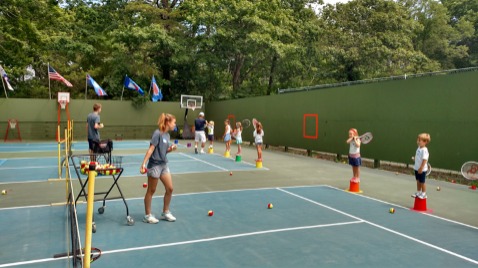
Join us at Hampton Racquet this summer on Tuesdays, Wednesdays, and Thursdays from July 2nd – August 30th from 3:45 – 6 p.m. The brand-new “Creative Arts & Tennis Afternoon Camp” introduces children ages 4-12 to the love of learning tennis. We provide masterful instruction from John Graham, racquets, age-appropriate groups, healthy snacks, drinks, and art materials with guided instruction. Inspired by the East End, children are exposed to a variety of creative themes, from local flora and fauna, to architecture and history, explored through a variety of mediums. This unique opportunity engages children in sports, constructive arts, science, nature exploration, games, and books for $99/day, with discounts available for 10+ classes. For more information or to register, email rebecca@shinenyc.net.

https://shinenyc.net/wp-content/uploads/2021/02/Shine-logo-300x220.png 0 0 Shine https://shinenyc.net/wp-content/uploads/2021/02/Shine-logo-300x220.png Shine2018-06-04 13:47:302024-09-26 15:59:04Why Tennis Lessons Are Great For Kids Under 10 — And How To Get Them Started

Easy Spring Plants To Get Young Children Interested in Gardening

May 8, 2018/in Fun, Learn, Make, Play/by Shine

A garden is one of the most beautiful gifts you can give your child. It’s a place of escape, where you can gaze upon the wonders of nature, and a method for demonstrating the positive benefits of hard work, patience, and tender loving care.

“Usually children spend more time in the garden than anybody else,” says Carol Williams in her book, Bringing a Garden to Life. “It is where they learn about the world, because they can be in it unsupervised, yet protected. Some gardeners will remember from their own earliest recollections that no one sees the garden as vividly, or cares about it as passionately, as the child who grows up in it.”

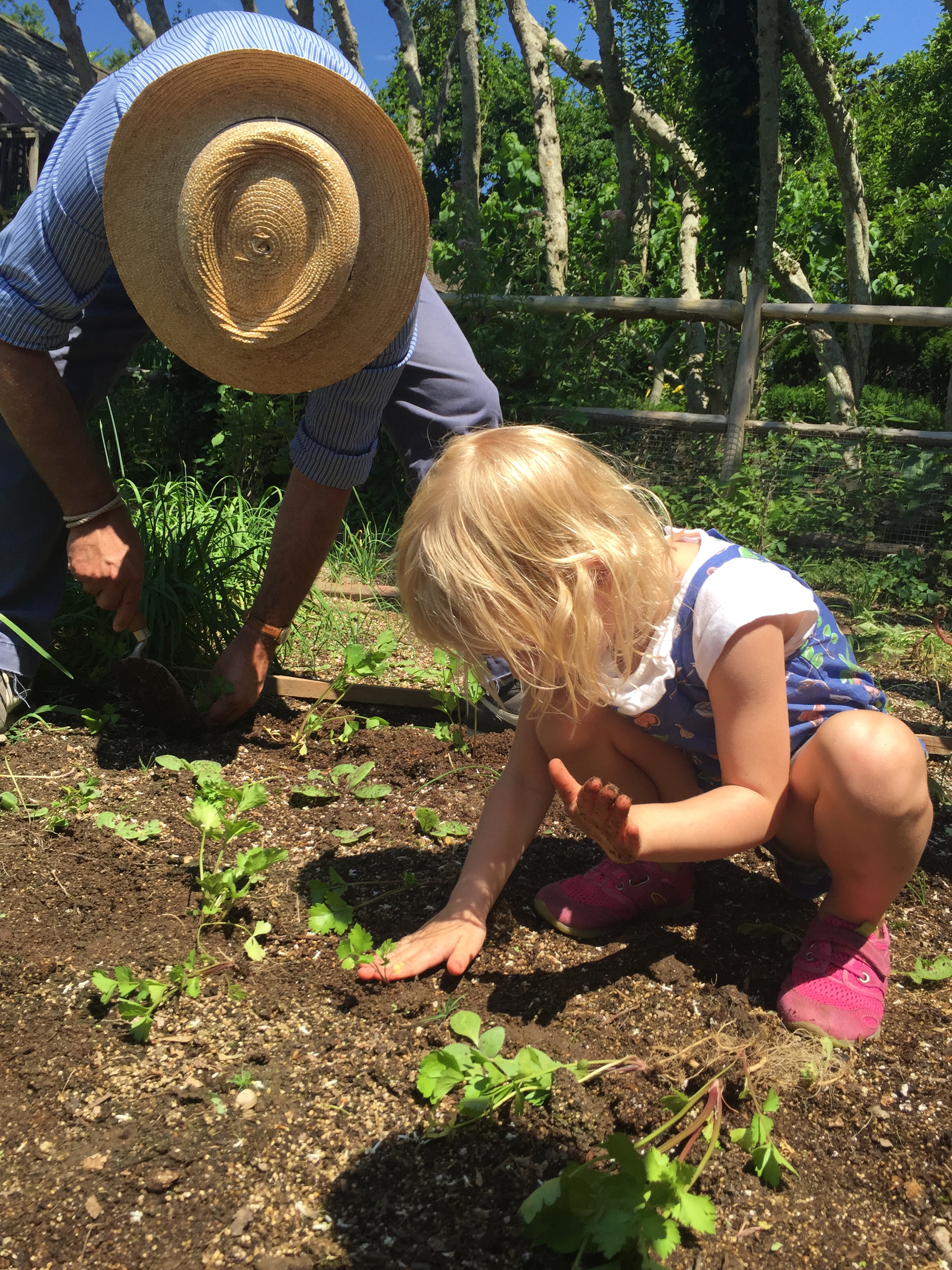
It’s never too early to expose your little ones to the joy of gardening, although there are certain obvious limitations. Prior to kindergarten, the wait can seem agonizing. The littlest ones are often appeased with rudimentary tools and the opportunity to get their hands dirty. Keep a watering, weeding, fertilizing, and projected growth date calendar for three and four-year-olds to maintain your child’s interest throughout the season.

Try the following plants to inspire your little “green thumb”:

Beans and Peas

Peas and beans sprout from seed within a week, making them the best beginner plants. Beans are so easy to grow, you can grab a few dried pinto, black, or kidney beans right from your cupboard, place them on a wet paper towel inside a plastic bag on a sunny windowsill, and watch them start to sprout before your very eyes. If you’d rather get your hands dirty outside, a bush bean variety like the “Purple Queen” is easy for kids to spot and pick. We also love this whimsical Bean and Morning Glory Teepee, which provides a fun outdoor playhouse for your child all summer long.

Plant: 1 inch deep, 3-4 inches apart

Sun: Full (about 8 hours/day)

Water: 1 inch per week

Herbs

Herbs like Mint or Basil are particularly hardy. They grow fast and furious in as little as four days, and can withstand a bit of stomping. Some toddlers will even pick and eat the fresh leaves. Chives and Cilantro take about 10 days to get going, but cilantro will require more careful care, as it has a tendency to bolt if it’s not cut back in time. Dill, Oregano, and Thyme can take two weeks to grow. Sage and Parsley are considerably slower with four weeks before germination. You can grow herbs in a pot, a windowsill box, or the ground.

Plant: Six to 10 inches down, 10-12 inches apart

Sun: Part Sun (about 4 hours/day)

Water: As needed – when soil feels dry to the touch

Sunflowers

Any kid who has ever read “Jack and the Beanstalk” will be astounded by a sunflower’s impressive growth. Dwarf varieties grow two or three feet tall, but Mammoth Russians, American Giants, and Giganteus sunflowers can reach 12 to 15 feet. The seeds begin to sprout in just seven to 10 days, with big bright flowers appearing in two months, and the first seeds developing three to four months later. To enjoy continuous blooms all the way until the first frost, sow a new row of seeds every two to three weeks.

Plant: Two feet down, two to three feet apart

Sun: Full (about 8 hours/day)

Water: Several gallons, once a week

Radishes

Radishes may not be your child’s favorite vegetable to eat, but they sure grow swiftly. The “Easter Egg” variety produces mature red, purple, and white vegetables in one month. The French enjoy radishes with butter and salt, the Koreans pickle them, Mexicans throw them into tacos, and the British put them on tea sandwiches. Here in America, we tend to chop them up into picnic salads with eggs and mayonnaise.

Plant: ½ inch deep, 12 inches apart

Sun: Full (at least 6 hours)

Water: 2-3 hours once the soil is dry four inches down

Cherry Tomatoes

Tiny tomatoes are the perfect fresh-off-the-vine food to snack on. Little hands can harvest ripened tomatoes planted from seedling in less than two months. Look for varieties like the Super Sweet 100, Sun Sugar, Black Cherry, and Husky Cherry Red for extra sweet flavor. If your child isn’t crazy about eating a raw tomato, you can turn them into tomato salsa, pasta sauce, soup, or bruschetta topping.

Plant: ¼ inch deep, 24 inches apart

Sun: Full (8 or more hours/day)

Water: 1.5 inches per week

Why Not Take A Class?

Shine’s “Garden Project” class, geared toward ages 3-5 or 5-7, is another ideal way to spark your child’s interest in gardening. Our projects combine art, science, and nature in highly engaging ways to foster lifelong learning, creativity, and Earth stewardship. Contact us for more details.


References:

http://www.gardendigest.com/family.htm

https://www.parenting.com/article/gardening-kids

https://garden.org/learn/articles/view/4056/

http://homeguides.sfgate.com/tall-can-sunflower-grow-year-70410.html

https://www.almanac.com/plant/sunflowers

https://www.epicurious.com/archive/blogs/editor/2014/04/the-tk-best-ways-to-eat-radishes.html

https://www.sciencekiddo.com/bean-seed-in-a-bag/

https://bonnieplants.com/library/the-basics-of-tomato-flavor/

https://shinenyc.net/wp-content/uploads/2021/02/Shine-logo-300x220.png 0 0 Shine https://shinenyc.net/wp-content/uploads/2021/02/Shine-logo-300x220.png Shine2018-05-08 16:34:282024-09-26 15:59:04Easy Spring Plants To Get Young Children Interested in Gardening

What Are NYC Parks Doing For Earth Day & Arbor Day?

April 17, 2018/in Guide, Learn/by Shine

Environmental conservationist Wendell Berry once said: “The world is not given by his fathers, but borrowed from his children.” This month, we have two excellent opportunities to get the kids outside, thinking about nature, and learning about good stewardship of the Earth. Even the littlest gardeners-in-training can understand the beauty of a flower, the joy of getting their hands dirty, and gratitude for the warm sunshine. New York City offers a bounty of beautiful parks to visit any day of the year – but, most meaningfully, on Earth Day and Arbor Day.

Celebrate Earth Day 2018 on April 22nd

Few cities do Earth Day like New York City. Rooted in 1970, Columbia University activists convinced the mayor to shut down Fifth Avenue for the day and encourage demonstrations in Central Park. About 100,000 people visited Union Square to express support for the holiday throughout the course of the day, with swells of 20,000 at any given time. The idea was to get Americans out into the spring sunshine to peacefully express their wishes for environmental reform.

Here are a few places to take the kids on Earth Day:

  • Wave Hill House – Sculpt a mini garden with brightly colored oil clay, take a free meditation session, plant a green-roof birdhouse, design your own gratitude flag for the community garden, and leisurely tour the 28-acre public garden in the Bronx with views of the Hudson River and Palisades. Its scenic beauty attracted the likes of Theodore Roosevelt and Mark Twain, so why not you, too?
  • Pelham Bay Park – Pelham Bay Park is the largest park in NYC – three times the size of Central Park, in fact. Among the 2,700 acres, you’ll see Orchard Beach, two golf courses, baseball fields, tennis courts, the historic Bartow-Pell Mansion, and salt marsh wetlands that attract egrets, herons, and red-winged blackbirds. For the 25th consecutive Earth Day, the disability-friendly Playground For All Children is host to a memorable day of arts and crafts, volunteer opportunities, sensory gardens, music, and live performances. The volunteer project starts at 10 a.m. Call 718-430-1891 for more details.
  • Fort Tryon Park – If you’re looking for a meaningful way to get older kids involved in volunteer work, join the Friends Committee of the Fort Tryon Park Trust and NYC Parks for their annual Beautification Day from 10 am to 2 pm in the Heather Garden. Wear sturdy shoes and long pants. Plants, tools, and gloves will be provided. Afterward, enjoy arresting views of the Hudson River, George Washington Bridge, and the Palisades.

If you’re in the mood for a family hike, the Urban Park Rangers will be doing guided tours at Flushing Meadows Corona Park (Queens), Seton Falls Park (Bronx), Inwood Hill Park (Manhattan), and Marine Park (Brooklyn). If you’re really into the activism aspect of Earth Day, you can take part in a number of events sponsored by the Earth Day Initiative throughout the month.

Celebrate Arbor Day 2018 on April 28th

The first American Arbor Day dates back to 1872, when newspaper editor and future Secretary of Agriculture Julius Sterling Morton oversaw the planting of one million trees in Nebraska City. The day was celebrated with a 1,000-person parade, each classroom planting a tree that they would tend to throughout the year, speeches from public dignitaries, and the singing of “America.” It became an official nationwide observance by 1882. Today, Arbor Day continues to be an important fortification against deforestation.

Try these NYC Arbor Day celebrations:

  • Wave Hill – Kids ages 5+ will love donning a hard hat and safety tree-climbing harness to explore the canopies of an old sugar maple at the Junior Arborist Station. Afterward, you can taste fresh maple syrup in the shop. Youngsters who like crafting are treated to a sensory experience, making bark rubbings out of wax paper, burlap, cheesecloth, leather, paper, and yarn. Educational guided tours round out this fun-filled Arbor Day celebration.
  • Prospect Park – The Audubon Center at the Boathouse invites you to a free day of crafts, games, and nature-inspired activities. Nature enthusiasts will receive a Discovery Pack nature activity kit, learn about the parks’ tree species on a guided tour, and spread mulch to protect tree roots.
  • Planting Fields Arboretum – From 11-4 on the 28th and 29th, bring children ages 4+ to see circus performers, face painters, Smokey the Bear, petting zoo animals, caricaturists, live music, railway exhibits, and seedling giveaways.

For hands-on tree planting fun, get involved at Battery Park (Manhattan), Evergreens Cemetery (Brooklyn), or contact the Million Trees NYC project to find out how your family can get involved.


Contact Shine to learn about our nature-themed enrichment activities and parties.

https://shinenyc.net/wp-content/uploads/2021/02/Shine-logo-300x220.png 0 0 Shine https://shinenyc.net/wp-content/uploads/2021/02/Shine-logo-300x220.png Shine2018-04-17 01:34:132024-09-26 15:59:04What Are NYC Parks Doing For Earth Day & Arbor Day?

Passover Activities For Kids

March 25, 2018/in Celebrate, Learn, Make, Party, Read, Taste/by Shine

Passover Activities For Kids

Passover is one of the most beloved religious holidays, celebrated by more than 70% of Jewish Americans. The story of Moses provides rich lessons about “standing up for equality, pursuing justice, and standing up for the rights of the marginalized… core Jewish commitments,” as Rabbi Rick Jacobs put it. Children are central to the Passover proceedings as a symbol of the continuity of the Jewish people, but the significance is likely to pass them by if we don’t go out of our way to include them in the family rituals. Incorporate some of these Passover activities to engage the youngest members of the faith.

Passover Pretend Play

  • The Big Clean – In preparation for Passover, families keeping Kosher kitchens remove all Chametz. Involve kids in the search party with a scavenger hunt to find hidden cookies under the bed, in pockets, closets, drawers, school bags, and toy chests.


  • Plagues – Scatter squishy green frogs or plastic locusts across the table to represent the plagues. Rite Lite Judaica sells Plague Masks that represent terrors like darkness, boils, wild animals, frogs, and cattle plague – or you could just as easily make your own out of construction paper.


  • Seder Set – Particularly from ages 3-5, children become fascinated with “playing adult.” KidKraft sells toy versions of the Seder plate, wine goblet, bottle of wine, matzo, afikomen and matzo covers, and a prayer book.

Passover Crafts

  • A Cup For Elijah – Families put out a cup of wine for the prophet Elijah at the Passover Seder. Toward the end of the dinner, they open the door to symbolically “let Elijah in.” For this craft, take a plastic Dollar Store wine goblet, paint a liberal strip of white craft glue around the top, and wrap a colorful piece of wool or jute string around the cup. Alternate with more glue and different colored strings for a rainbow look. Add sequins or gems.


  • Red Sea Diorama – The parting of the Red Sea makes for a great mini scene. Upcycle cardboard by cutting it into at least six curvy wave shapes in a variety of sizes, covering them in blue tissue paper. Affix the waves into slits cut into a cardboard base, using glue to secure them. Don’t forget to leave a path down the middle. You can make little people out of corks, dressing them in felt clothes, bottle cap hats, and yarn hair, and drawing faces with black marker.


  • Matzo Cover – Use a plain white handkerchief or cut a square out of a choice piece of fancy fabric. Just be sure it’s bigger than a piece of matzo. Decorate the cloth with oversized gems, embroidered grapes or spring flowers, and puffy paint border embellishments. Paint the Hebrew word for Passover to make it extra relevant.

Passover Cooking

  • Shine’s Favorite Jewish Recipes – We’ve rounded up five delicious, easy Jewish recipes to make with kids, including Potato kugel, Soup Dumplings with Minced Brisket, Kookoo-e Sabzi, Braised Short Ribs with Squash Puree and Roasted Corn Salad, Quinoa Salad with Pomegranate and Pistachio.


  • Passover Pizzas – What kid doesn’t love pizza? Pre-heat a baking stone at 500 degrees for a half hour. Mix 2 ¼ cups of all-purpose white wheat flour, ½ tsp. sea salt, and 1/3 cup olive oil in a food processor. Add ½ cup of water. Form into 12 dough balls and roll on a floured surface until cracker-thin. Prick holes with a fork to prevent bubbling. Cook for one minute per side. Reduce heat to 250 degrees. Top with pizza sauce, mozzarella, and your favorite toppings or seasonings, cooking for 15 minutes more.


  • Macaroons – Widely considered thee flourless dessert of Passover, macaroons come in many designs from almond to raspberry, but we like this basic chocolate-dipped coconut recipe. Whisk together 1 large egg white, 2 TBSP honey, ¼ tsp pure vanilla, the grated zest of one lemon, and 1/8 tsp of coarse salt. Stir in 1.5 cups of fine-shredded unsweetened coconut. Make 15 balls with a 1.5” ice cream scoop and bake them on a parchment-lined baking sheet for 12 minutes at 375 degrees, rotating halfway through. Before serving, drizzle with 2 ounces of melted dark chocolate and refrigerate 15 minutes to set.

If you’re looking for more ways to incorporate Jewish culture into the lives of your children, ask us about our Vitamin J Jewish art and cultural class for kids of all ages. We explore basic Judaica in a variety of fun, creative ways.

Additional Children’s Passover Resources:

USA Today – Passover Holiday Explained, https://www.usatoday.com/story/news/world/2016/04/22/passover-jewish-holiday-explained/83387514/

Amazon – KidKraft Passover Set, http://amzn.to/2HBNsce

Tori Avey – Elijah’s Cup Craft, https://toriavey.com/home-garden/family-fun-elijahs-cup-passover-craft

Creative Jewish Mom – Splitting of the Red Sea Diorama, http://www.creativejewishmom.com/2010/03/kids-crafts-for-pesach-krias-yam-suf-the-splitting-of-the-red-sea-diorama.html

Cooking with my Kid – Mighty No-Sew Matzah Cover, http://cookingwithmykid.com/2011/04/12/mighty-matzah-cover

Martha Stewart – Coconut Chocolate Macaroons, https://www.marthastewart.com/1098219/coconut-chocolate-macaroons

Disgustingly Good – Matzo Pizza, http://disgustinglygood.com/2012/03/31/matzo-pizza/


https://shinenyc.net/wp-content/uploads/2021/02/Shine-logo-300x220.png 0 0 Shine https://shinenyc.net/wp-content/uploads/2021/02/Shine-logo-300x220.png Shine2018-03-25 12:45:182024-09-26 15:59:04Passover Activities For Kids

Constructive Play is the Secret to Cultivating a Creative Mind at Any Age

January 23, 2018/in Guide, Learn, Play/by Shine

Parents are inundated with advertisements for hundreds, if not thousands, of toys claiming to make their children “smarter” or more interested in math and science careers. Yet, the vast majority of these assertions are empty promises, backed by no evidence whatsoever. Today’s children spend an enormous amount of time in front of TVs, computers, and video games – with unknown long-term effects. Early evaluations suggest diminished ability to process information, recall, and concentrate.

Building blocks are a timeless classic, with stones and rocks likely a child’s earliest playthings. In 1693, English Philosopher John Locke referenced alphabet blocks as a way to make learning to read a more enjoyable experience. Numerous scientific studies make the case for block play as a brain-building activity. From mathematics and science, to fine motor skills and literacy, blocks set the foundation for learning. Though oft-overlooked for its simplicity, the building block is a gold mine for skill building in our midst.

How Does Block Play Affect the Developing Mind?

Decades of research show that children who play with blocks:

  • Excel in math over a decade later, and show a particular interest in STEM careers.
  • Are better at counting, adding, subtracting, and using spatial language like “above” or “below.”
  • Developed better spatial intelligence, 3-D modeling, and visualization.
  • Perform better at divergent problems after playing with chunky foam blocks than with puzzles.
  • Form stronger social relationships and high-quality friendships by cooperating with others.
  • Score higher on tests of vocabulary, verbal comprehension, and grammar as toddlers.
  • Display improved competence in math, spatial reasoning, and executive control in 1st
  • Have bigger 1st grade vocabularies, particularly after playing with town and community blocks.
  • Are 31-38% better at performing complex mathematical word problems in 6th
  • Develop strong spatial language and reasoning by speaking and collaborating with others.
  • Score above average in language assessments, despite low-income environments.
  • Show marked brain scan activation in regions associated with motor and spatial processing.

Beyond scientific measurements of achievement, children engaged in block play are flexing their creative muscles, as they dream, build, and express themselves. They gain confidence as they stack the tower higher and overcome small adversities. Children first discover that they can bring their unique ideas to life. They explore the notions of object continuity and permanence. As they work in a group setting, they are studying the work of others, cooperating, taking turns, sharing materials, asserting themselves, and boosting their attention spans.

Stages of Block Play

The National Association for the Education of Young Children notes eight different stages of block building that children advance through:

  1. Discovering blocks – exploring the physical properties of carrying, dropping, and packing.
  2. Stacking blocks – using repetition to create basic structures.
  3. Complex stacking – incorporating dramatic play as rows become train tracks or highways.
  4. Making enclosures – engaging in more pretend play to imagine animal pens and houses.
  5. Creating bridges or arches – exploring trial and error by connecting blocks together.
  6. Combining enclosures and bridges – advancing to more daring and complex combinations.
  7. Building with patterns and symmetry – sorting, seeking equivalency, and tending to details.
  8. Building block structures that represent pretend playobjects – roleplaying and planning.

Make Your Block Play More Constructive

There’s always room for involved parents to join the fun. Experts recommend:

  • Making time each day for blocks at home.
  • Supporting the child’s decision making with positive statements.
  • Prompting (ex: “Let’s build a castle”), but following the child’s lead.
  • Talking about shapes, sizes, colors, and number of blocks while playing.
  • Using spatial words like “beside,” “beneath,” “over,” “under,” and “above” to narrate.
  • Asking open-ended questions about the building process (like “Do you think it’ll balance?”)
  • Adding in character toys, cars, zoo animals, or other structures to encourage pretend play.
  • Cutting animal pictures in half and taping them to Mega Blocks to encourage matching.
  • Saving household materials like boxes, cans, and Popsicle sticks for creative building.
  • Occasionally changing the scenery, taking blocks to the garden, sandbox, or the park.
  • Experimenting with Edo Blocks, Jumbo Blocks, or Giant Waffle Blocks (preschool & up).
  • Using pictures, diagrams, or games to encourage specific construction projects (for older kids).
  • Combining block play with story time, illustrating parts of the story with blocks and accessories.

Join the Shine Block Party!

Block Party, one of our signature classes and workshops, is the perfect introduction to the constructive arts for the Legos-Lover. Aspiring architects experiment with different building materials, from sugar cubes and marshmallows, to tree blocks and sculpting materials. We also offer custom classes of up to 12 sessions for advanced builders. Parents and kids alike love our hands-on approach that feels like free-spirited fun, but also lays the foundation for math, science, and artistic talents for years to come.

RESOURCES:

  • https://www.parentingscience.com/toy-blocks.html
  • https://www.parentingscience.com/Lego-bricks-construction-toys-and-STEM-skills.html
  • https://www.naeyc.org/resources/pubs/yc/mar2015/ten-things-children-learn-block-play
  • http://www.sheknows.com/parenting/articles/844895/lessons-to-teach-while-playing-with-blocks
  • https://littlebinsforlittlehands.com/kids-build-lego-creations/
  • http://www.huffingtonpost.co.uk/entry/the-joy-of-building-blocks-for-very-small-children_uk_599565a5e4b0acc593e55588
  • https://handsonaswegrow.com/lots-of-blocks-activities/
  • https://teaching2and3yearolds.com/fun-block-activities-for-toddlers-and-preschoolers/
  • https://playedo.com/en/
  • https://www.sciencedaily.com/releases/2013/09/130924091804.htm
  • https://www.npr.org/sections/ed/2015/02/12/385264747/q-a-blocks-play-screen-time-and-the-infant-mind
  • http://bayareadiscoverymuseum.org/blog/block-play-math-skills/

By Jenn Fusion for Shine

Jenn Fusion is a Buffalo, NY based wordsmith with more than a decade of experience researching, writing, and editing informative and insightful articles for business clients. Her work has been featured online and in print editions of USA Today, the Atlanta Journal-Constitution, and The Houston Chronicle, as well as niche publications for vice presidents, celebrities, music, and beer. You may have seen on Huffington Post Live TV or heard her on Minnesota Public Radio. Best of all, she’s the mother of busybody toddlers Josephine and Henri.
https://shinenyc.net/wp-content/uploads/2018/01/Block-1.jpg 1686 1575 Shine https://shinenyc.net/wp-content/uploads/2021/02/Shine-logo-300x220.png Shine2018-01-23 23:05:442024-09-26 15:59:04Constructive Play is the Secret to Cultivating a Creative Mind at Any Age

Why Your Kids Should Learn a Second Language

January 16, 2018/in Guide, Learn/by Shine

“One language sets you in a corridor for life. Two languages open every door along the way.”

– Psycholinguist Frank Smith


Young children naturally absorb new information like sponges and delight in the process of learning. Language instruction is a beneficial experience for toddlers as young as three years old. Not only does it give you something fun to do with them, but there are many developmental, social, and economic benefits. At Shine, we make second language learning interactive, engaging, and fun.

Key Facts on Learning A Second Language at an Early Age

Children who learn a second language have better:

  • Tolerance and intercultural awareness
  • Academic performance on SAT and ACT tests
  • Risk assessment and analytical decision-making
  • Creativity, mathematical scores, and basal ganglia function
  • Maintenance of focus and attention, despite external stimuli.
  • Vocabularies, working memory, and problem-solving abilities
  • Ability to gain language fluency due to gray matter increases
  • Chance at becoming an executive, as two-thirds speak multiple languages, earning 5-20% more
  • Protection from Alzheimer’s, with onset delayed by as much as five years.

Choosing A Second Language For Your Child

You may consider choosing:

  • A heritage language that carries cultural and personal significance, like German or Italian.
  • A profitable language like Mandarin Chinese, which analysts say is ideal for career development.
  • A popularly spoken language, such as Spanish, Chinese, Arabic, or French.
  • Kid-friendly languages like Spanish, found in TV (Dora the Explorer) and books (Skippyjon Jones).
  • An etymological language like Latin, which helps kids understand the root of English words.
  • Easier languages to learn that are written and pronounced the same, such as Spanish or Italian.

What Does It Take For Children To Learn?

Linguists say the most effective teachers are parents, caregivers, immersion schools, and living abroad. Daily preschool classes can be helpful – but only if backed up by foreign language books and time spent with au pairs or babysitters who speak the language. Toddler programs and once-a-week classes train the ear to help kids get a head-start on learning the language later.

“To really learn a foreign language, children must spend 30 percent of their waking time exposed to it,” Christina Bosemark, founder of the Multilingual Children’s Association, told the NY Times. Children with less exposure will have the capacity to understand the language, but will be hindered in speaking it correctly.

Susan Behrens, associate professor of communication sciences and disorders at Marymount Manhattan College, adds: “If you introduce a language in the spirit of play and being embedded in their daily lives, you’re going to be much more successful than if you say, ‘Okay, you’re going to class now.’”

Parents Love Shine’s Listillos Language Immersion Program

One of our most popular programs is Listillos, a Spanish immersion class that uses storytelling, music, visual arts, games, and dance to give children a better understanding of the language and culture. Children as young as pre-school will spend time learning vocabulary and culture based around a particular theme, while older kids will delve into the culture of Spanish-speaking countries with art activities featuring Dia de los Muertos flowers, luchador masks, Colombian, molas, and Aztec codex. Going one step further, the Listillos Uno-a-Uno program adds in private, one-on-one instruction that includes cooking, field trips and advanced art projects. A native Spanish speaker teaches this bilingual class designed for ages 2-10.

By Jenn Fusion for Shine

Jenn Fusion is a Buffalo, NY based wordsmith with more than a decade of experience researching, writing, and editing informative and insightful articles for business clients. Her work has been featured online and in print editions of USA Today, the Atlanta Journal-Constitution, and The Houston Chronicle, as well as niche publications for vice presidents, celebrities, music, and beer. You may have seen on Huffington Post Live TV or heard her on Minnesota Public Radio. Best of all, she’s the mother of busybody toddlers Josephine and Henri.
https://shinenyc.net/wp-content/uploads/2017/08/Listillos.jpg 853 2001 Shine https://shinenyc.net/wp-content/uploads/2021/02/Shine-logo-300x220.png Shine2018-01-16 01:24:582024-09-26 15:59:04Why Your Kids Should Learn a Second Language
Page 9 of 11«‹7891011›»

Recent Articles

  • Helping Kids Navigate Post-Election AnxietyNovember 16, 2024 - 11:52 pm
  • Weekly Adventures Around the World: Cultural Learning Through PlayJuly 5, 2024 - 2:39 pm
  • Nurturing Healthy Habits: 5 Benefits of Cooking With Your KidsMay 31, 2024 - 12:33 pm
  • Mental Health Awareness Month: Spotlight on TweensMay 25, 2024 - 1:11 pm
  • Joyful Journeys: The Benefits of Raising Puppies for Children Ages 0-12April 28, 2024 - 7:07 pm
  • Celebrate Siblings Day: Fun Ideas for Family BondingApril 9, 2024 - 2:57 pm
  • Five Unique Twists on Spring Egg DyeingMarch 15, 2024 - 3:43 pm
  • Spring Into Science: 5 Easy Experiments for Kids to Enjoy at HomeMarch 1, 2024 - 4:42 am
  • Half-Day vs. Full-Day Camps – What’s Best for Your Child?February 16, 2024 - 6:49 pm
  • Igniting Creativity: Celebrate National Inspire Your Heart With Art Day with KidsJanuary 15, 2024 - 5:35 pm
  • Early Childhood Education Plays a Crucial Role in a Post-Pandemic WorldJanuary 11, 2024 - 12:15 am
  • Fun New Year’s Crafts That Spark Creativity and JoyDecember 22, 2023 - 9:52 pm
  • Building Family Bonds: One Brick at a TimeDecember 19, 2023 - 6:47 pm
  • Harvesting Confidence: A Guide to Helping Children Overcome Negative Self-Talk During Pre-AdolescenceNovember 28, 2023 - 7:13 pm
  • Celebrating World’s Children Day on November 20thNovember 16, 2023 - 4:08 pm
  • 12 Reasons to Introduce Your Child to Photography as a HobbyOctober 21, 2023 - 8:13 pm
  • Fall Fun: East End’s Pumpkin Patches and Crafty IdeasOctober 3, 2023 - 2:04 am
  • https://www.longislandadvance.net/stories/patchogue-unidos,93162
    Celebrating Hispanic Heritage Month: Family-Friendly ActivitiesSeptember 10, 2023 - 6:07 pm
  • The Summer of Canadian Wildfires: How To Explain the Effects of Climate Change With Your ChildAugust 6, 2023 - 4:36 pm
  • Be Sure To Pack In These Sweet End-of-Summer CelebrationsAugust 3, 2023 - 4:26 pm
  • Summer Strategies for Building Healthy Tech HabitsJuly 31, 2023 - 12:28 am
  • Essential Social Skills for Your Kids—And How To Help Build ThemJuly 20, 2023 - 3:20 pm
  • Long Island Family Camping Adventures: Benefits, Activities & DestinationsMay 17, 2023 - 10:51 pm
  • DIY Memorial Day Gifts: Fun Crafts for Kids and AdultsMay 14, 2023 - 5:56 pm
  • Funny Business: Exploring the Benefits of Family Laughter in National Humor MonthApril 26, 2023 - 5:40 pm
  • 8 Fun Easter Traditions from Around the WorldApril 3, 2023 - 10:02 pm
  • How To Throw a Spring Color PartyMarch 23, 2023 - 4:04 pm
  • Women’s History Month: 3 Changemakers, Crafts, & CookiesMarch 23, 2023 - 3:48 pm
  • Happy Lunar New Year!January 24, 2023 - 5:33 pm
  • 4 More Ways to Encourage Resilience in ChildrenJanuary 11, 2022 - 12:00 am
  • 10 Ways for Families to Practice GratitudeNovember 11, 2021 - 8:48 pm
  • Resolutions Your Kids Can Make – and Keep – in 2026December 22, 2025 - 4:47 pm
  • 10 Fun & Mindful Ways to Keep Kids Engaged This Holiday Season (Without Screen Overload)December 22, 2025 - 4:33 pm
  • Beyond the Toy Box: Meaningful Holiday Gifts for Kids That Last Longer Than the Wrapping PaperNovember 29, 2025 - 12:20 pm
  • What to Do if Your Child Is Obsessed with a TV ShowNovember 22, 2025 - 8:02 am

Categories

  • Celebrate (137)
  • Front Page Blog (102)
  • Fun (119)
  • Guide (219)
  • Learn (110)
  • Make (60)
  • Party (31)
  • Play (67)
  • Read (21)
  • Shine 9 (8)
  • Style (2)
  • Taste (49)
  • Uncategorized (4)

Subscribe To Our Newsletter

Shine Logo

ServicesEventsAboutBlogContact
212-414-5427
info@shinenyc.net
For Media Inquiries, Contact media@shinenyc.net
Location New York, NY 10036
Location Sag Harbor, NY 11963
Follow Us
FacebookTwitterPinterestInstagramYoutube

Site Map | Copyright ©2025 Shine Creative, Inc.

Website and SEO by RazorRank

Scroll to top